Why we have conflicts with people around us and how to approach them
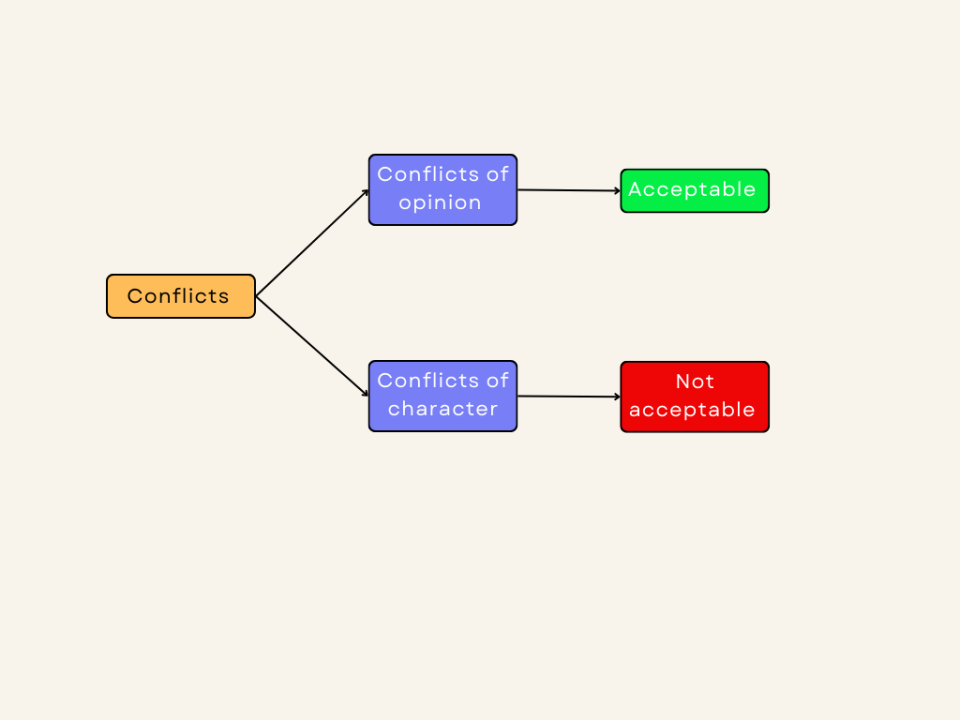
Having conflicts with people around us can be taxing — specially because we lose our time and peace of mind. If we know how to approach conflicts better, everything around can get simpler.
Conflicts, generally, can be either of these two — ‘conflicts of opinion’ or ‘conflicts of character’.
Conflicts of opinion
Opinionsare fluid — they change with time. And they should. If your opinions don’t evolve over time, it means that you’re not meeting new people, you’re not reading new books or that you’re not exploring different ways of thinking. Most people stick to their opinions as they progress — get settled — start a family — run it with the opinions that they have had for so long — only to see the next generation knock it out in one second. This is what we can call a “generation gap”.
It is very common for conflicts to arise out of different opinions. In fact, I take such conflicts as opportunities to see if it is time to update my opinion. If your mind is flexible enough to understand this, you will realize that it is not very difficult to live with people who have contrastingopinions. In fact, it is completely okay to accept contrasting opinions because sometimes the best way to know the worth of some opinions is by living them or experiencing them. There is only one exception here — yourcharacter.
Conflicts of character
In our mind, we all have principles on what is right and what is wrong. These are the principles and rules that we live by. What you call as your “principles of right and wrong”, other people call as your “character”. Likeopinions, your “character” or your “principles of right and wrong” should evolve with time.
Like I said, it can be comfortable to accept contrasting opinions sometimes to see if they are really worth it. However, unlike opinions, accepting contrasting characters may not feel comfortable. The reason for that is we can learn to accept contrasting opinions as long as they gel with our “character” or our “principles of right and wrong”. But accepting a contrasting character means breaching the principles of right and wrong that we live by — it is like cheating on yourself. So, how does it impact our lives?
The impact is that you can build long lasting relationships — professional or personal — only with people who have acharactersimilar to yours even if they haveopinionswhich are different from yours.
How to approach conflicts?
Conflicts of opinion are opportunities — to learn and evolve. If you introspect, you will surely be able to attribute some part of your personal and professional growth to the conflicts of opinion that you have had with people around you.
But when you observe that a situation is violating your character, it is important to take a stand for your character with all the power and confidence that you have — or risk losing your character. You may ask — people let go of their principles all the time depending on the situation, so who cares? The answer to that is simple — people will eventually know and they will no longer trust you or anything that you say. In other words, there is cost of taking a stand for your character and that is — it has to be absolute. There are no exceptions at all.
An example of that is Arjuna. He raged war against his family in the Mahabharata war because they had tried to violate his “character” or his “principles of right and wrong”. You may count this example as one of the extremes but the principle remains the same — cost of taking a stand for your character is absolute and it has no exceptions at all.
And this is like1 Bit of Evolution.And it brings us to the question: The cost of taking a stand for your character in a conflict — Will you bear it?
hashtag#conflictresolution hashtag#psychology hashtag#peoplemanagement